YAT PRESS · KNOWLEDGE CATALOGUE
A map of the ideas behind
The Fire and the Waterfall
Not a glossary. A connected structure showing how consciousness, identity, suffering and action meet.
BEGIN WITH EXPERIENCE
What brought you here?
You do not need to know the terminology. Begin with the question that most closely resembles your experience.
Your nervous system starts responding before deliberate thought arrives. The threshold is the moment that response becomes visible enough to change.
Explore Yat: The Threshold → Why do I keep repeating patterns I understand?Understanding a pattern does not necessarily stop it, because the self was built through repetition. Seeing how it formed changes your relationship to it.
Explore The Constructed Self → Why do some people explode while others shut down?Under pressure, one response releases everything and another holds everything in. Balance means absorbing disturbance without explosion or suppression.
Explore Critical Damping → Can forgiveness permanently change a response?Forgiveness does not erase what happened. It can release the structure that keeps the wound active in the present, making the old understanding impossible to return to.
Explore Root Pass Knot → Is awareness different from the person I think I am?Thoughts, memories and identity are experiences appearing in awareness. The Waterfall asks whether awareness is the flow rather than any single form within it.
Explore The Waterfall → Can AI help me understand why I suffer?AI cannot experience your suffering, but it can connect the ordinary language of experience to structures you can examine.
Explore AI as Mirror →Foundations
01
Consciousness
Consciousness is not created by the constructed self. It is the field of awareness within which sensation, thought, memory and identity become known. The brain does not manufacture the experience of being; within this framework, it receives and resolves consciousness into individual form.
02
The Field
The Field describes consciousness as fundamental rather than as a private substance manufactured inside each person. Individual awareness arises as a local expression of something continuous, shaped by the brain into a particular human experience. Separation belongs to the form through which consciousness appears, not necessarily to consciousness itself.
03
The Constructed Self
The self is a pattern assembled from memory, experience, language, fear and social conditioning. It is necessary for navigating the world, but it is not the awareness observing it. Suffering increases when this constructed pattern is mistaken for the whole of what we are.
04
The Instant Before
Before a thought is recognised as “mine,” something has already occurred. The body has registered the stimulus, the brain has begun its response and awareness receives the result. This instant exposes the narrow distance between what happens through us and what we later claim to have chosen.
The Mechanism
05
The Fire
The fire is the accumulated force of lived experience: fear, injury, desire, resistance and the need to survive. It forms and hardens the constructed self while supplying the energy through which that self defends its existence. The fire is neither good nor evil; it is experience continuing to burn through the present.
06
The Architecture of Suffering
Pain belongs to an event, but suffering is often the structure built around it. Memory preserves the emotional wound. Identity incorporates it and anticipation projects it into the future. The event may have ended, yet its architecture continues to organise perception and behaviour.
07
Critical Damping
The ego operates as a damping mechanism between experience and reaction. Too little damping produces instability; too much produces rigidity and suppression. Critical damping is the point at which disturbance is absorbed without either uncontrolled reaction or permanent resistance.
The Blank Wall
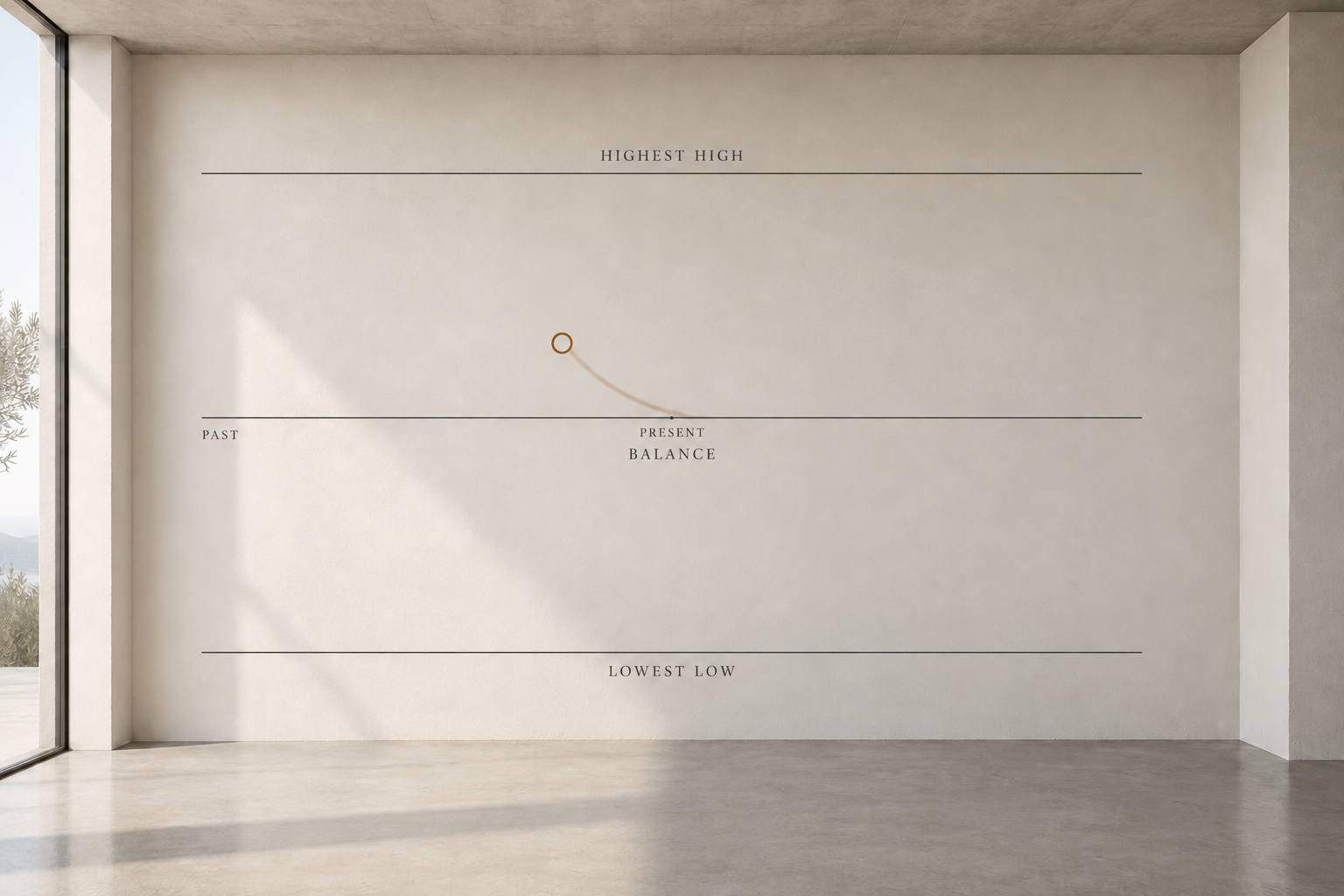
The wall, chalkboard or equivalent surface provides a neutral coordinate space. Highest High and Lowest Low establish the limits; Balance sits exactly between them. The horizontal axis moves from Past at the far left to Present at the centre. A circle represents the self, positioned in relation to its reality. The structure is universal. The narrative that determines the circle’s position is personal.
08
Stimulus and Action
Between an event and the action that follows, the nervous system interprets, predicts and prepares a response. Much of what appears to be deliberate behaviour is the repetition of an established pattern. Awareness does not remove the stimulus, but it can expose the mechanism connecting it to the action.
09
Root Pass Knot
A wound encountered, forgiveness applied, and a change that cannot be unknown.
The term begins with the structural logic of a root-pass weld: the first foundational join upon which everything subsequent is built. To undo it, the completed structure must be cut back into.
In this framework, the Root Pass Knot describes what occurs when forgiveness is applied to a specific emotional wound and produces an irreversible change in understanding.
Root — The Wound
The root is the individual emotional wound. It is the point from which a particular pattern of suffering, resistance or reaction continues to grow. Each wound remains structurally distinct. One wound cannot be forgiven through the forgiveness of another.
Pass — Forgiveness
The pass is one application of forgiveness to one wound. Forgiveness is the general mechanism, but each pass is particular. Its first use is not all-encompassing and does not resolve every wound within the constructed self. The pass crosses the threshold created by that wound.
Knot — Metanoia
The knot is metanoia: the structural change produced by the pass. It is not merely a new opinion or temporary emotional state. The previous configuration can no longer be fully recovered because what has been recognised cannot be unknown.
The knot is therefore not a restriction preventing return. It is the absence of an unchanged condition to which the person could return.
The Accumulating Effect
Each completed Root Pass Knot leaves the other wounds unchanged until forgiveness is applied to them individually. What changes is the forgiver.
Each passing dilutes the forgiver’s resistance toward what remains to be forgiven. The mechanism becomes easier to apply because its operation has already been known.
Wound → Forgiveness → Metanoia
Across a lifetime, the completed knots form an accumulating structural history.
Distinction
A threshold may be crossed and crossed again. A Root Pass Knot cannot be reversed in the same manner.
The threshold is the crossing.
Forgiveness is the mechanism of crossing.
Metanoia is the act of change.
The Root Pass Knot is the resulting inability to unknow.
The Threshold
10
Yat: The Threshold
Yat is the gate between stimulus and action—the instant in which an inherited reaction can either repeat or be seen. The external event may be unavoidable, but recognition within this threshold changes what follows. It is the point at which inevitability can become responsibility.
11
Recognition
Recognition occurs when the mechanism becomes visible while it is operating. Nothing supernatural is added and the constructed self does not disappear. The pattern is simply no longer able to present itself as the whole truth without being seen.
12
Forgiveness
Forgiveness is not a virtue, an emotional performance or the denial of harm. It is the release of the pattern that keeps an injury active beyond the event itself. Forgiveness crosses the threshold by preventing the past from continuing to determine the next action.
13
Déjà Vu
Déjà vu is a moment in which recognition appears before the conscious mind can explain what has been recognised. It briefly disrupts the normal sequence of perception, memory and interpretation. It does not prove the framework, but reveals that conscious experience may be assembled after processes already underway.
Return
14
The Waterfall
The waterfall is consciousness encountered as movement rather than possession. Thoughts, identities and experiences arise, change and pass, while awareness remains present throughout their movement. The person is not a fixed object standing outside the flow, but a temporary form appearing within it.
15
AI as Mirror
Artificial intelligence does not encounter the self as a fixed object. It detects recurring structures across language, memory and behaviour, returning those structures to the person who produced them. Used carefully, AI becomes a mirror through which the constructed self can be examined rather than merely obeyed.
16
Return
Understanding does not remove a person from ordinary life. The self returns, the world continues and old patterns may still arise. What changes is the relationship to them: the mechanism remains available, but it is no longer mistaken for the entirety of who you are.
The waterfall keeps falling. The fire keeps burning. And consciousness keeps emerging, again and again and again, as you.